
Every year players spend hours trying to improve their 10m, 20m and 40m sprint times. Straight line speed is obviously important, but rugby is very rarely played in a straight line.
One of the interesting debates in American Football is why some players with average 40-yard sprint times consistently look faster on the field than players with much better testing scores. Players such as Jerry Rice and more recently Puka Nacua were never amongst the quickest over 40 yards, yet repeatedly found ways to create separation and outrun defenders in matches.
Part of the answer is that running fast in sport is often very different to running fast on an athletics track.
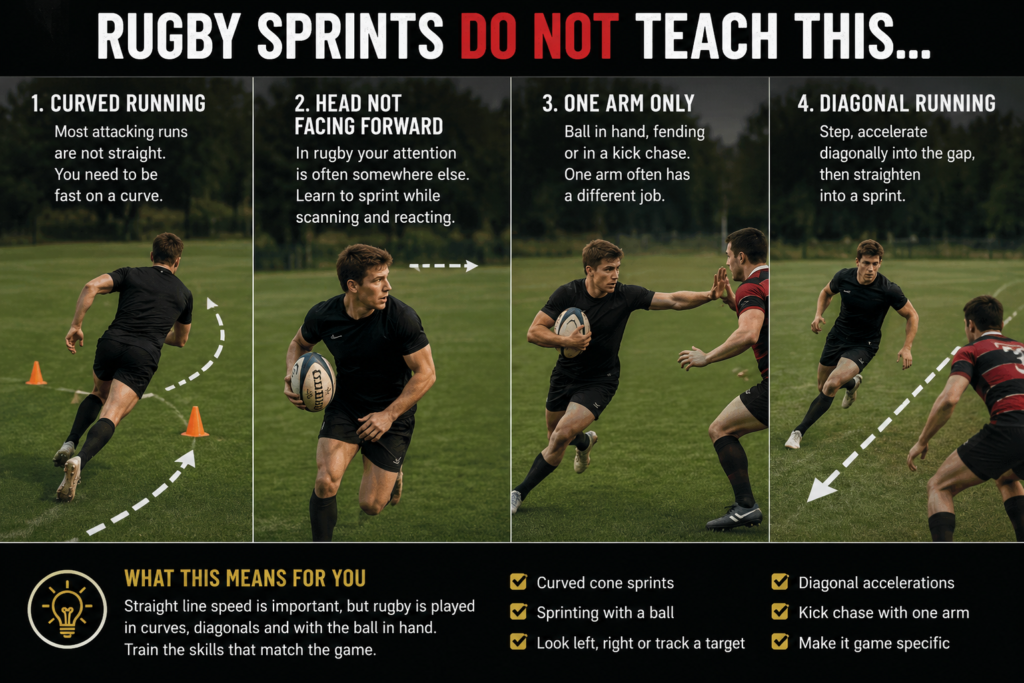
Curved Running
Very few attacking runs are perfectly straight. Wingers chase kicks on a curve, players arc around defenders and support runners often loop into space rather than sprinting directly towards it.
Curved sprinting uses the body differently to straight sprinting and takes practice in its own right. If every sprint you perform in training is between two cones in a straight line, you are only preparing for a small percentage of the movements you will use in a game.
Your Head Is Rarely Looking Straight Ahead
When sprinting on a track your eyes are normally focused straight ahead. In rugby your attention is often somewhere else.
You may be watching the defender in front of you, scanning for support runners, tracking the flight of the ball or looking across field while still trying to accelerate.
Learning to sprint while your head is turned slightly in different directions is a useful skill that most players never deliberately practise.
Sprinting With One Arm
Athletics teaches symmetrical arm drive because both arms are free to move.
Rugby does not.
If you are carrying the ball, fending an opponent or competing in a kick chase, one arm often has a completely different job to the other. This changes balance, rhythm and mechanics, yet many players only ever practise sprinting with both arms moving normally.
Diagonal Running
One of the most common acceleration patterns in rugby is not straight ahead but diagonal.
Think about beating a defender one-on-one. You step, accelerate diagonally into the gap and only straighten up once you are through. The same thing happens when chasing across in defence or supporting a line break.
Learning to accelerate diagonally before transitioning into a straight sprint is far more game specific than simply repeating straight accelerations.
What Does This Mean For You?
Continue to develop your straight line speed, but remember that rugby places many more demands on your running than a simple sprint test.
Try adding some of the following into your speed sessions:
Curved cone sprints.
Sprinting while carrying a ball.
Sprinting while looking left, right or tracking a moving target.
Diagonal accelerations before straightening into a sprint.
Kick chase drills where one arm is used for balance or hand contact.
The more closely your sprint training reflects what actually happens in a match, the more likely it is to transfer onto the rugby field.
Photo – Curved sprinting during rugby training, carrying the ball at speed and accelerating diagonally through a gap –
*******************************************
For support, training plans or simply to ask a question please contact me.
***********************************************
For Rugby Fitness Training, Rugby Training and Rugby Fitness talk ensure you are subscribed to the newsletter here on Rugby Fitness Training
***************************************